Guide
Pitch deck examples: the slides investors expect
The standard structure of a startup pitch deck, what each slide has to show, public examples worth studying, and how to send the deck so you know who read it.
In short
- A first-meeting pitch deck has 10 to 15 slides, in the order investors ask their questions.
- The core slides: problem, solution, why now, market, product, traction, business model, competition, team and the ask.
- One point per slide, readable without you there to present it.
- Send it as a link, not an attachment, to see when it is opened and which slides each investor read.
The standard pitch deck structure
Most decks answer questions in the order investors ask them: what is wrong, how you fix it, how big it gets, whether it works, why you.
Investors' own guides, such as Sequoia Capital's guide to writing a business plan and the Y Combinator guide to a seed round pitch deck, describe close variants: 10 to 15 slides.
Also common
Many decks add a title slide, a financial summary and a contact slide. Lead with traction if it is your strongest point.
Public pitch deck examples worth studying
Few real decks are published; founders and investors share some on their blogs, often years later.
LinkedIn, Series B, 2004
Reid Hoffman, LinkedIn's co-founder, published his Greylock deck with notes on what worked and what he would change.
When you study a deck, look at
- Which slide comes first: their strongest point.
- How traction is shown.
- What is left out.
Copy the structure, never the content.
Design: what matters and what does not
One idea per slide
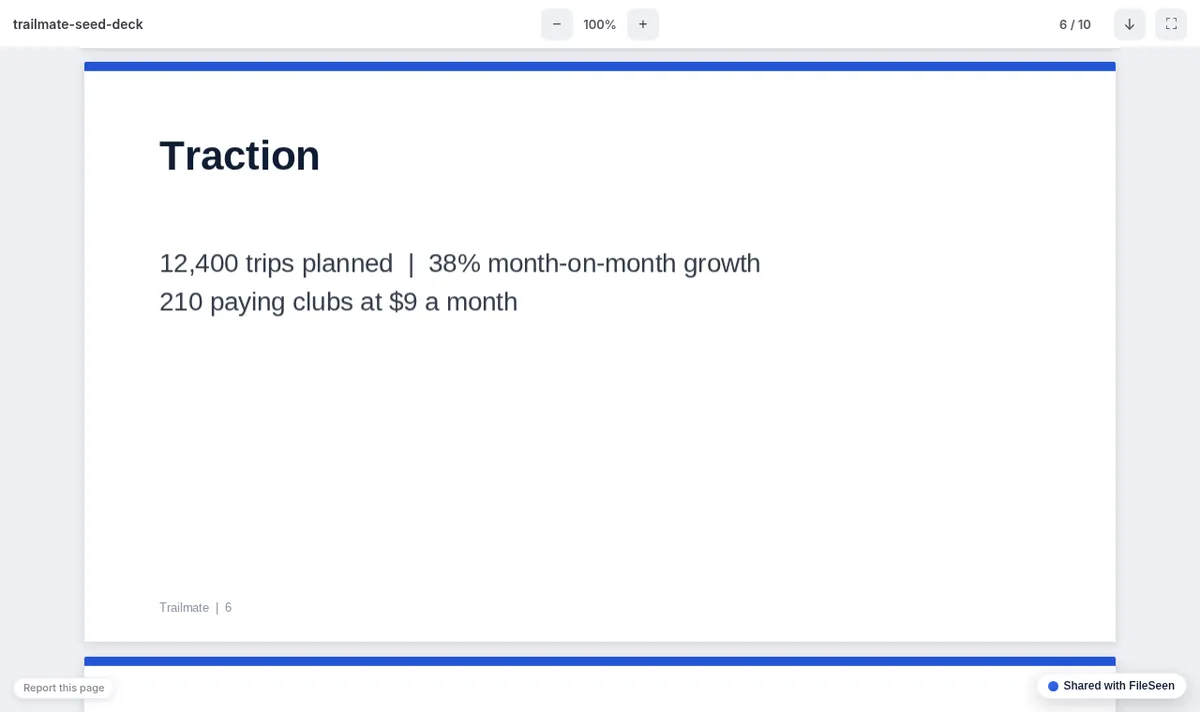
A headline that states the point: "Revenue tripled in six months", not "Traction".
Readable without you
Each slide stands on its own for readers who missed the meeting.
Large type, real numbers
If a figure needs a footnote to be true, it needs rewriting.
A PDF, not the editing file
Same on every screen, no speaker notes or old versions.
Is a pitch deck just a PowerPoint?
It is made in PowerPoint, Keynote or Google Slides, but it is a short argument for investing, one point per slide.
Investors read it as a PDF, often without you. If it only works with a speaker, it is not ready to send.
Pitch deck templates: what to take from them
Take the slide order and a clean layout. The numbers and the story have to be yours.
Do
- Rewrite each title as its point: "Traction" becomes "40 paying teams in five months".
- Swap stock photos for real product screenshots.
Avoid
- Keeping a slide you cannot fill with something true.
- Padding a market slide with industry figures.
What decks that raise money tend to have in common
A clear first slide
What you do, and for whom, in seconds.
Evidence over adjectives
Dated numbers and named customers.
Honest competition
Real alternatives and trade-offs.
A specific ask
Tied to next-round milestones.
Short
10 to 15 slides; detail waits for the meeting.
Two decks, not one
Send the short one first: it decides whether you get the meeting.
The deck you send ahead
Short, readable without a presenter.
The deck you present
More visuals, less text, used in the room.

How to send a pitch deck and know who read it
An attached PDF disappears into an inbox. The right time to follow up is right after someone reads it.
With FileSeen, the PDF becomes a link that opens in any browser.
- An email every time it is opened.
- Opens, countries and total reading time on the stats page.
- Ask for the reader's email first, see who opened it and the time on each slide.
- One link per investor, so you can tell their reading apart.
Habits that help
- Keep the deck view-only unless an investor asks for a copy.
- Set an expiry date on decks with sensitive financials.
- Update the file behind the link when numbers change.
- Follow up on what they read: a long stay on the market slide is a question waiting.
Send your deck as a link
Get an email every time it is opened, then follow up on what was read.
FAQ
Pitch deck questions
How many slides should a pitch deck have?
Ten to fifteen for a first meeting. Detail beyond that belongs in an appendix or a follow-up.
Should I send my pitch deck as a PDF?
Yes. A PDF looks the same everywhere. Sending it as a link rather than an attachment also tells you when it is opened.
Is a pitch deck the same as a business plan?
No. A business plan is a long document with detailed financials; a pitch deck is a short visual summary meant to win a meeting.
What is the most important slide?
Usually traction, if you have it, because it is evidence rather than a claim. Before launch, the problem and the team carry the deck.
More from FileSeen